Archival Photo Paper: How Long Prints Really Last
Last Updated: November 24, 2026
Quick Summary
Archival photo paper can keep a finished print stable for a long time in dark storage when the paper, ink, and storage conditions all hold up, but no single lifespan applies to every print. The paper itself has a much shorter shelf life before printing, so unused stock and finished prints run on two different clocks.
- Unused photographic paper has a usable life of at least a few years at room temperature.
- Silver-gelatin prints are the most stable of the three technologies in dark storage.
- Pigment inks outlast dye inks under light, and better coatings block UV and moisture.
- Retire old paper if two or more steps of the six-step test fail.
- Store paper flat, keep boxes off concrete floors, and add a desiccant packet in humid climates.
Table of Contents
- How long does archival photo paper last?
- What actually decides how long a print survives
- How long does inkjet photo paper last?
- Does photo printer paper expire?
- Photo paper long-term storage: temperature, humidity, and packaging
- Archival matte paper vs luster photo: which finish lasts longer
- What archival really means, and what it does not promise
- Choosing Wall Art Built to Outlast the Trend
- Frequently Asked Questions
How long does archival photo paper last?
Archival photo paper can keep a finished print stable for a long time in dark storage when the paper, ink, and storage conditions all hold up, but no single lifespan applies to every print. The paper itself has a much shorter shelf life before printing.
That gap confuses a lot of buyers. One clock measures the paper before you print. The other measures the print after. They run at different speeds, and mixing them up leads to bad decisions.
Unused paper and finished prints are two different clocks
Unused photographic paper is light-sensitive stock with an expiration date. Krueger Photo's guidance on paper storage notes that fresh paper has a usable life of at least a few years at room temperature, and that clock starts ticking the day it leaves the factory.
Finished prints work differently. Once the image is processed and dry, the paper stops being light-sensitive. What matters then is how the emulsion, ink or dye, and coating hold up over decades.
So when someone asks how long does archival photo paper last, the honest answer depends on which stage they mean. Here at American Luxury Gifts, we print on Fuji Crystal Archive paper.
What actually decides how long a print survives
Print life is a chain, and the weakest link sets the limit. Paper base, emulsion, coating, ink or dye, printing process, and storage environment all pull on the same rope. A premium paper paired with a weak ink or a damp closet will fade long before its rated years.
Paper base, emulsion, and coating
The paper base is the foundation, usually a treated wood pulp or cotton rag sheet. The emulsion is the light-sensitive layer that holds the image. The coating sits on top and shields both from air, moisture, and light.
A weak base yellows. A thin emulsion loses contrast. A poor coating lets pollutants reach the image. For a deeper look at how one popular paper degrades and how to slow it, see our guide on why Fuji Crystal Archive paper fades.
Ink, dye, and printing process
Inkjet prints rely on pigment or dye inks sitting on a coated surface. Dye inks fade faster under light; pigment inks resist better. Silver gelatin and chromogenic prints lock color into the emulsion itself, which is why darkroom prints often outlast inkjet ones.
Fox Print's 2026 overview of photo paper longevity makes the same point: paper alone cannot determine print life. The ink and process carry equal weight.
How long does inkjet photo paper last?
Inkjet photo prints can hold an image for a long time in dark storage, but display conditions shorten that span. The honest answer is a range, not a single number, because lifespan depends on illumination, framing, and storage conditions.
Longevity by print technology and paper composition
The paper is only one link in the chain. How the image is formed matters just as much, and the three common technologies age differently:
- Silver-gelatin (traditional darkroom): The image is metallic silver suspended in a gelatin emulsion. Under dark storage these prints are the most stable of the three, often rated in the 100-year range and beyond when processing and washing are complete. Under display light they hold up well but can silver-mirror at the edges if poorly fixed or washed.
- Chromogenic (RA-4 color, including Fuji Crystal Archive): Dyes are formed in the emulsion during processing. Dark-storage stability is strong, but the dyes are more light-sensitive than silver, so display life depends heavily on UV filtering and illumination levels. Coatings and paper base quality separate a long-lived chromogenic print from a short-lived one.
- Inkjet (pigment or dye): Pigment inks sit on a coated surface and resist light far better than dye inks. Dye inks can shift noticeably within a few years on a bright wall. Coating quality controls how well the ink resists moisture, ozone, and handling.
Paper composition reinforces the same pattern. A cotton-rag or treated wood-pulp base with a good barrier coating slows yellowing and pollutant ingress. A thin coating or an acidic base undermines even a stable image layer.
What the published numbers actually assume
When you see a lifespan figure, ask what conditions produced it. Most estimates assume moderate illumination, UV-filtered framing, and stable temperature and humidity. Change any of those and the number moves. A print rated for decades in an album can fade in a few years on an unfiltered south-facing wall. Treat any single figure as a best-case scenario tied to its test conditions, not a guarantee for your wall.
Fox Print's 2026 overview of photo paper longevity makes the same point: paper alone cannot determine print life. The ink and process carry equal weight.
Three variables drive the difference in practice:
- Ink type: pigment inks outlast dye inks under light
- Coating quality: better coatings block UV and moisture
- Display light: high illumination accelerates fading
Ultraviolet light is a major factor in fading a displayed print. Glass with UV filtering can help, and keeping prints out of direct sun is advisable.
Does photo printer paper expire?
Photo printer paper can age over time, and opened paper is more exposed to air and humidity. Old paper may show fogging, yellowing, and weak contrast.
A step-by-step test for aged paper
Before you load an old box into a printer, run this check:
- Inspect the edges. Yellow or brown rims mean oxidation has started.
- Smell the sheet. A sharp chemical odor signals breakdown.
- Print one test print. Use a small sheet with a full color range.
- Check the whites. Foggy or gray whites mean the paper is spent.
- Watch the contrast. Muddy shadows point to a weak emulsion.
- Let it sit 24 hours. Fresh color shift means the paper is failing.
If two or more steps fail, retire the box. A test print costs little; a ruined project costs more.
Photo paper long-term storage: temperature, humidity, and packaging
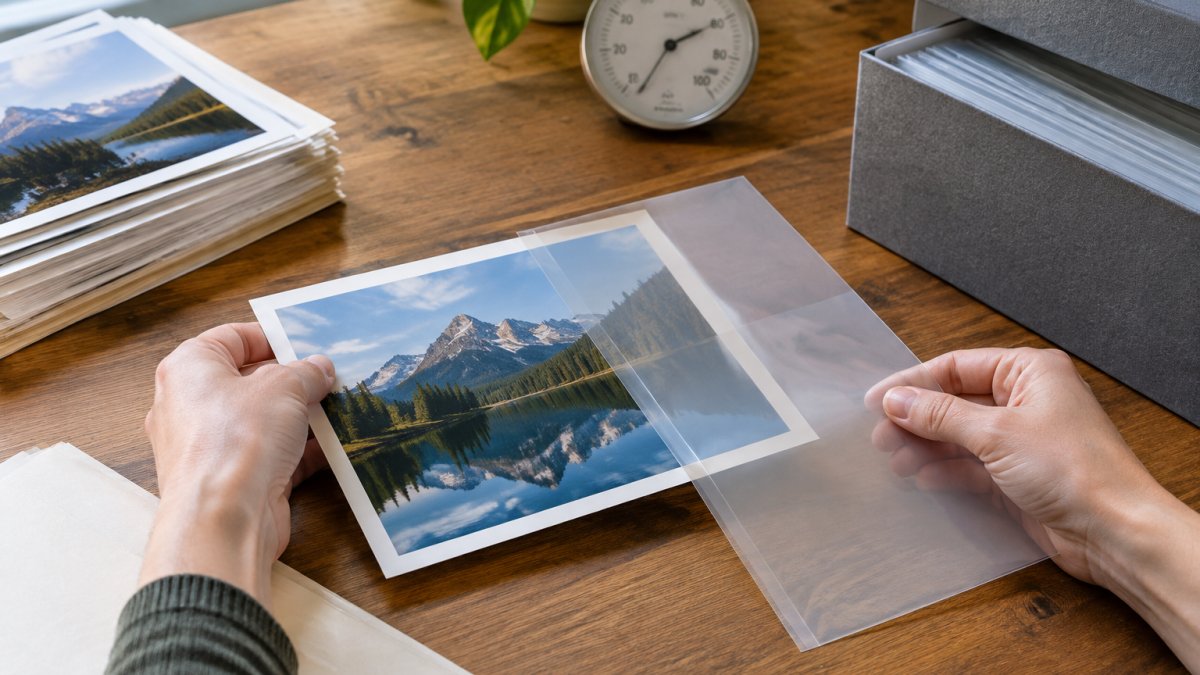
Photo paper long-term storage comes down to three controls: cool temperature, low humidity, and sealed packaging. Keep a stable room temperature and moderate humidity, and keep the paper in its original packaging until you print. Check the insert or data sheet that came with your paper for the maker's storage guidance.
Distinguish manufacturer guidance from general advice
Manufacturers publish storage recommendations for their specific emulsions and coatings, and those recommendations should be followed. Stability matters: a steady room is better than a space with large temperature and humidity swings, because repeated expansion and contraction can stress the emulsion and coating.
Packaging and sealed storage
Unused paper is most vulnerable before it is printed, so packaging does real work:
- Keep unopened packages sealed until you are ready to print, and reseal opened packages in their original bag or a zip-style moisture barrier.
- Store paper flat, never rolled or bent, and keep boxes off concrete floors and away from exterior walls where condensation forms.
- Add a desiccant packet to opened packages in humid climates, and let cold paper come to room temperature before opening it to avoid condensation on the emulsion.
- For finished prints, use acid-free sleeves and boxes, and avoid attics, basements, and garages with wild temperature swings.
- Handle prints by the edges to keep oils off the surface.
Watch out: opening a cold package straight from a cold car or storage room can pull moisture onto the paper surface and cause fogging or mottling that no printer setting will fix.
Moisture and heat do the most damage. For step-by-step cleaning and handling once prints are out of storage, our guide on cleaning archival photo paper prints safely walks through the process.
Archival matte paper vs luster photo: which finish lasts longer
Neither finish wins outright. The difference between matte and luster is mainly how they handle light and handling.
| Feature | Archival Matte | Luster Photo |
|---|---|---|
| Surface | Flat, no glare | Slight sheen, soft reflection |
| Fingerprints | Shows easily | Wipes off easily |
| Glare under glass | Minimal | Some reflection |
| Color depth | Softer, muted | Richer, deeper blacks |
| Best for | Framed art, low-glare rooms | Vivid prints, high-traffic walls |
Matte hides glare but picks up smudges. Luster resists fingerprints and holds richer color. Both need UV-filtering glass and stable humidity to reach their rated years.
What archival really means, and what it does not promise
"Archival" is a marketing term, not a regulated standard. Spectrum Photo's explanation of archival labeling points out that no universal standard defines how long an archival item lasts. Imaging Arts Printing's paper standards says it only uses the label for paper tested to last 100 years.
That means the word tells you the maker tested something. It does not promise your print will hit a specific age. Storage, framing, and display conditions decide the rest. Ask what was tested, and how.
Choosing Wall Art Built to Outlast the Trend
Longevity should shape what you hang, not just how you store it. A print on quality paper, framed with UV-filtering glass and kept out of harsh sun, is better protected against fading.
That is the standard we build to at American Luxury Gifts. Every piece is handmade in Virginia on high-resolution Fuji Crystal Archive luster paper. Our curated collections cover motivational, abstract, and thematic art.
Customers have said the prints look even better in person. If you are ready to pick a piece, our guide to meaningful wall art prints and our advice on choosing and styling prints for your home help you get size and style right the first time.
The real test of archival photo paper is not the label on the box. It is the paper, the ink, the framing, and the room it lives in.
American Luxury Gifts makes that choice easier. Our wall art is handmade in Virginia on Fuji Crystal Archive luster paper, built for high resolution and lasting clarity.
Frequently Asked Questions
Does archival paper fade over time?
It can, because the label alone does not lock in a lifespan. The term archival is not a single regulated standard, and no universal standard defines how long an archival item lasts in storage. Fading also depends on the ink or dye, the coating, the printing process, and where the print hangs. A print in direct sun will shift color long before one kept in a dark, dry room.
How should I store photo prints for decades?
Keep prints in dark storage at room temperature, away from humidity, heat, and air exposure. Use acid-free sleeves or boxes, keep the original packaging for unused sheets, and avoid attics, garages, and basements where moisture swings. Frame display copies behind UV-filtering glass and store the master print flat. Handling with clean hands and avoiding tape directly on the image also slows discoloration and yellowing.
What is the difference between archival paper and regular photo paper?
Regular photo paper is built for everyday printing, while archival photo paper is marketed around longer image stability. The gap is not a fixed number of years. Paper base, emulsion, and coating all affect how a print resists fading, yellowing, and color shift, and the ink or dye matters just as much. Treat archival as a quality signal, not a guarantee, and check how the print will be displayed.
How long do inkjet photo prints last?
There is no single figure. Inkjet print longevity depends on the paper, the ink set, the coating, and the storage or display conditions. Dark storage at room temperature preserves color far longer than a sunny wall. Sealed packaging, UV-filtering framing, and low humidity all extend usable life. For anything you want to keep for decades, print on quality paper, frame behind UV glass, and keep a flat stored copy.


