Patio Wall Art Prints for Outdoor Furniture and Color Palettes
What makes the best patio wall art prints? Choose them for the patio’s exposure, not just to match the furniture. Consider sun and moisture first, then select a size and palette that suit your furnishings. Outdoor artwork may have UV-protective coatings or water resistance, but water-resistant does not mean fully waterproof.
Patio art can bring the space together without feeling out of place or fading into the background. The right design can echo your furniture, add a considered pop of color, and make a bare wall feel more personal.
This guide explains how to choose artwork for sheltered and exposed spots, scale it to your wall and furniture, and build a cohesive color palette. You’ll also find practical ways to balance bold designs with existing outdoor décor and choose confidently for your space.
Key Takeaways
- Choose artwork with its actual sun and moisture exposure in mind, not just its appearance.
- Coordinate the art with your patio furniture by repeating an existing color or using a deliberate accent shade.
- Leave room to adjust the palette: screen colors may look slightly different in person.
- Give outdoor artwork space from the wall so moisture can dry more readily.
- Measure the wall and nearby furnishings before choosing a print size, then consider whether one piece or a grouped arrangement suits the space.
Matching Art to Outdoor Furniture and Color Palettes
Choose a print that picks up a color or material in your furniture, then add a contrasting accent if the patio needs definition. For secure hanging on stucco, brick, or siding, use hardware suited to the wall surface and artwork’s weight, and follow the installation instructions.
Pairing Prints with Furniture and Color
Start with a visible feature, such as navy cushions, a teak table, or black metal chairs. Repeat one of those colors in the artwork for a coordinated look, or choose a complementary shade for contrast. Warm yellows, for example, can enliven charcoal seating, while muted blue and sand tones can echo a neutral outdoor rug.
Next, consider how many colors already compete for attention. If patterned cushions and striped umbrellas dominate, choose art with a simpler palette. On a restrained patio with solid beige cushions, a vivid botanical image can become the focal point. Matching doesn’t mean duplicating every fabric: one repeated color is often enough to make the arrangement feel intentional.
Selecting Outdoor Images and Motifs
Choose a motif that suits how you use the space. Ocean horizons and beach scenes reinforce a coastal setting, while leaves, flowers, or hummingbirds bring a garden wall into the overall design. For family meals, a welcoming message may feel more fitting than a dramatic landscape. A bold abstract image can anchor a patio with simple furniture and a bare wall.
Consider the image’s dominant colors as well as its subject. A sunflower motif, for instance, introduces yellow that can connect with cushions or planters. A calm blue-and-cream horizon can balance dark furniture without adding another busy pattern.
Canvas, Metal, and Secure Hanging Options
Canvas and metal create distinct visual effects. Canvas can give a garden image or ocean scene a softer, more traditional presence. Metal designs often suit modern furniture, clean lines, or a graphic sun motif. Some outdoor artwork has a UV-protective coating to help reduce fading in direct sun. Water resistance doesn’t mean fully waterproof, and ongoing exposure to the elements may change the artwork over time.
Some outdoor artwork comes with brackets or hooks for screw mounting on different wall types. Match the method to the surface: stucco and brick need compatible anchors, while siding installations should reach suitable structural support rather than rely on the siding alone. Follow the artwork’s hardware instructions; no single fastener suits every wall.
Use this three-step palette check before choosing: identify the patio’s main furniture color, find a print that repeats or complements it, then compare the image’s contrast with nearby patterns. Pair patterned cushions with a simpler metal design, for example, or use a colorful canvas print to enliven solid teak furniture. This connects the wall art to the space without making every element match.
What Is the Best Material for Outdoor Wall Art?
No single material suits every patio. Choose based on direct sun, rain, and humidity. Protect artwork by placing it in a sheltered spot and choosing a print with a UV-protective coating, while remembering that water-resistant does not mean waterproof.
Water and Weather Resistance
Water-resistant artwork can handle some moisture, but ongoing exposure to the elements may change it over time. A covered patio wall offers more protection than a spot exposed to wind-driven rain. Place a canvas print beneath a deep roof overhang, for example, rather than on an uncovered garden wall. Match the material’s stated resistance to the conditions it will face.
Consider how rain reaches the wall, not just whether the patio has a roof. Open sides can let wind push water toward artwork, and nearby sprinklers may cause repeated splashes. If a wall gets wet after storms, choose a more sheltered location or bring the print indoors during harsh weather. Indoor placement also suits artwork that needs more protection.
Water resistance describes a limit, not immunity from moisture. Don’t treat a coated print as fully waterproof or leave it exposed through every season. A canvas piece near a covered dining table faces different conditions from artwork beside an open railing. Keep that distinction in mind when considering how ongoing exposure may affect the material.
Corrosion, UV, and Moisture Protection
Metal designs add a crisp, dimensional look, but the finish matters in damp settings. Look for product details describing weather suitability rather than assuming every metal print resists corrosion. A sheltered wall beside an outdoor kitchen, for instance, may experience humidity and cooking moisture even without direct rainfall. Place metal art away from routine splashes, and consider its mounting hardware, too.
Sun exposure can affect color as well as material. A UV-protective coating helps prevent fading in direct sun, but it doesn’t make artwork immune to prolonged outdoor conditions. Compare the wall’s exposure throughout the day: a bright west-facing wall receives stronger afternoon light than a shaded wall beneath a porch roof. Use that difference to guide placement.
Moisture can linger behind artwork mounted close to a wall. Leave a small gap for airflow so dampness can dry more quickly. This is especially useful on a covered patio where humid air may remain around a shaded wall. Avoid placing the print against a surface that stays wet after rainfall.
Protection from Patio Conditions
Use placement as your first layer of protection. Choose a wall beneath a roof overhang, away from direct sprinkler spray and open edges where wind can drive rain. A canvas print on a sheltered porch wall has less exposure than the same piece beside an uncovered railing. If no protected wall is available, display the artwork indoors instead.
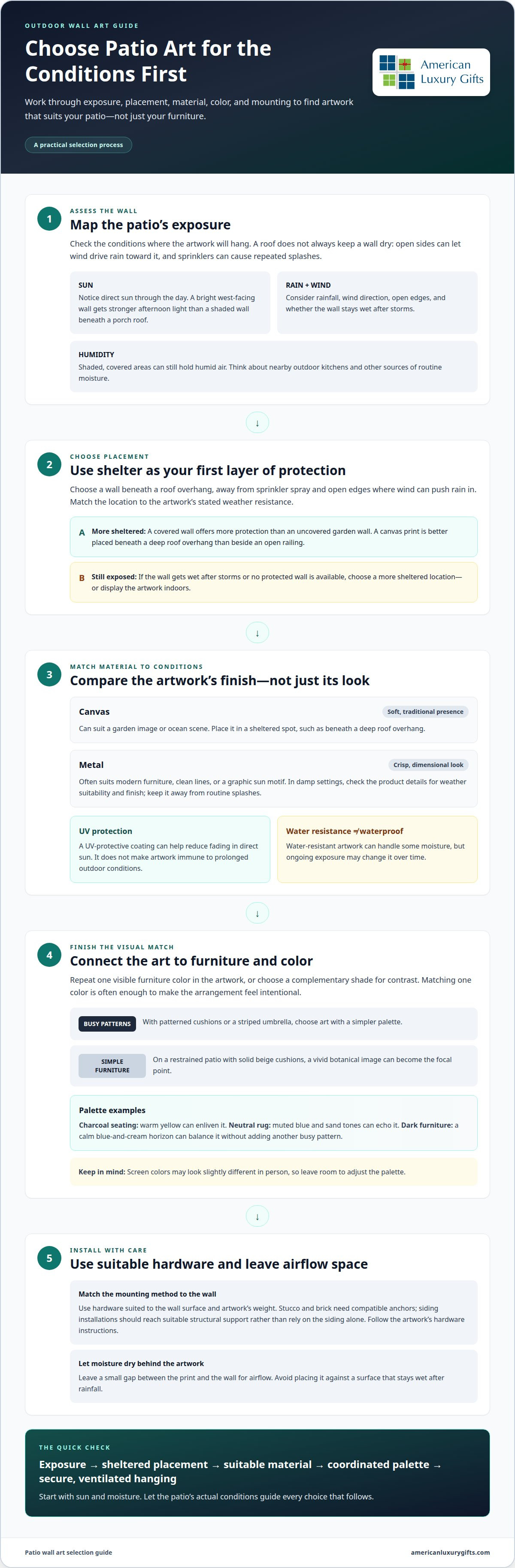
Before hanging, assess four conditions: direct sun, rainfall, wind direction, and humidity. A patio with strong afternoon sun and open sides, for example, needs a more protected location than a screened area beneath a roof. Secure the artwork with suitable hardware, then leave airflow space behind it. After storms, check for standing water or moisture around the frame and let the area dry.
During severe seasonal weather, or when the patio will remain unused, bring the artwork inside. This reduces prolonged exposure to rain and humidity. Even a coated print can change over time outdoors, so a covered location and sensible storage help preserve its appearance.
Choosing Artwork for Exposed or Sheltered Areas
Match the artwork to the patio wall’s actual exposure, not just the roofline. A covered porch can still receive slanting rain, strong afternoon sun, or damp air. Compare a wall beside an open railing with one farther beneath the roof. Conditions can differ even within the same seating area.
Map the wall before choosing a print. Notice where sunlight falls during the day, which direction rain comes from, and whether the spot is near sprinklers or plants that need watering. A wall beside an open patio entrance, for example, may get wind-driven rain, while the wall behind a dining table stays drier. Let these observations guide material and placement.
For a sheltered wall, consider a print suited to occasional outdoor exposure, and mount it where it won’t sit against dampness. A covered dining nook can suit a colorful canvas image that ties the table area together. Leave a small gap behind the artwork so moisture can dry more quickly. A roof helps, but water-resistant artwork isn’t fully waterproof.
An exposed location calls for more caution. Direct sun can contribute to fading, and continuous exposure to outdoor elements may change artwork over time. A UV-protective coating helps prevent fading in direct sun, but it doesn’t remove the effects of weather. For example, avoid placing a favorite print on the wall that receives the patio’s strongest sun and rain if a more protected wall is available.
Wind affects the choice, too. Artwork near an open edge may face gusts and sideways rain, unlike a piece on a recessed wall. Use hanging hardware suited to both the wall and artwork, and follow the product’s installation directions. If a location feels too exposed, choose an indoor wall that shares the patio’s color palette instead.
Use this location check before settling on a spot:
- Sun: Compare a bright wall with a shaded wall, especially during the afternoon.
- Rain: Look for water reaching the wall during a storm, including from open sides.
- Airflow: Allow space behind the piece so dampness can dry.
- Seasonal use: Choose a sheltered location for a print you want to keep displayed, or bring it indoors during severe weather.
A covered porch with an open side, for instance, may still expose a welcome sign to wind-driven rain. Moving it to a wall beside the entry, beneath the roof, can reduce direct exposure while keeping the design visible. You can also hang a print indoors, where it echoes patio colors without facing outdoor conditions.
Available Print Sizes
Choose a print size by comparing the artwork with the wall, furniture, and viewing distance. A compact piece can suit a narrow porch column, while a larger wall may need a wider focal point or a grouped arrangement. Measure the open wall area first, then consider how the print relates to a nearby bench, dining table, or doorway.
Product dimensions can describe different formats, so read each listing carefully. One listed 3D metal hummingbird wall art measures 12.3 by 16.5 inches. A welcome-to-our-porch sign measures 23.6 by 15.7 inches. Those examples provide a useful sense of scale: the hummingbird is a more compact accent, while the porch sign occupies more wall space.
A listed outdoor metal sun and moon wall art measures 13.26 inches. Because that listing gives one measurement, don’t assume it describes the width, height, or diameter without further product details. A patio print listing also includes a three-pack measuring 13.5 by 8.5 inches. A set can spread color across a longer wall, while one sign can create a single point of focus.
Use this measuring sequence before settling on a format:
- Mark the available area. Measure the wall space between architectural features, such as a door frame and a corner.
- Compare nearby furniture. Note the bench or table width, then picture the print above it.
- Mock up the footprint. Use paper cut to the listed dimensions, such as 23.6 by 15.7 inches, to see how the sign sits in place.
- Check the composition. Leave room for visual breathing space around a single piece or between items in a set.
For example, paper cut to the hummingbird’s 12.3-by-16.5-inch dimensions can show whether that piece feels balanced beside a porch chair. A paper outline matching the 23.6-by-15.7-inch sign can help you judge its presence above an entry bench. These mockups make scale easier to assess before mounting.
Consider the viewing position, too. A piece above a seated dining area should be visible from the chairs, while a welcome sign near an entry should read clearly as guests approach. On a long wall behind a patio table, a listed three-pack may create a more distributed arrangement than one compact accent. Let the wall shape and furniture placement guide your choice.
Finally, compare the artwork’s dimensions with the exact mounting area, not the full wall. A window, light fixture, or railing can interrupt the available space. Measure those boundaries and test a paper outline to find a scale that feels intentional rather than crowded.
Patio artwork can add a personal touch to an outdoor area or entry. Choose a design that suits the atmosphere you want, from a quiet corner to a space for guests.
Browse Welcome & Patio Wall Art Prints for designs to consider for your space. Before displaying any print outdoors, check the product’s stated materials and care guidance; suitability depends on those details. American Luxury Gifts also offers Motivational Wall Art Prints, Inspirational Wall Art Prints, and Christian & Spiritual Wall Art Prints for other rooms. Choose words and imagery that express what matters to you.
Browse the collection and check each listing’s dimensions, materials, and care guidance before choosing a design.
Frequently Asked Questions
What materials are best for weatherproof patio wall art prints?
Choose artwork whose product details explicitly describe its intended outdoor use; the material name alone doesn’t establish weather suitability. Before selecting a piece, read its care instructions and any stated placement limits. This matters especially if you want to leave the art displayed through changing seasons. An attractive finish or outdoor-themed image doesn’t, by itself, mean the artwork is designed to withstand weather.
Are outdoor patio wall art prints UV-resistant and waterproof?
Some products may offer protection against sunlight or moisture, but one feature doesn’t automatically mean the other. Treat UV protection and water resistance as separate product claims. If a listing mentions one, don’t assume it promises the other. A coating described as helping prevent fading, for example, doesn’t establish that a print can be exposed to rain. Use the product description to understand its stated protections.
What sizes and formats are available for patio wall art prints?
American Luxury Gifts offers unframed and framed prints in 8×10, 11×14, 11×17, 16×20, and larger formats. Single prints and curated multi-piece sets are available. The 8×10 prints use Fuji Crystal Archive luster photo paper; sizes 11×14 and larger use 100 pt heavyweight matte cardstock. For example, choose a set when you want a coordinated grouping rather than one standalone piece.
How do metal, canvas, wood, and acrylic patio prints compare outdoors?
Metal, canvas, wood, and acrylic differ in appearance and surface, but those names alone don’t tell you how a particular piece performs outdoors. Compare the product’s stated material, finish, care guidance, and intended placement before choosing. American Luxury Gifts’ print materials are Fuji Crystal Archive luster photo paper for 8×10 and 100 pt heavyweight matte cardstock for 11×14 and larger, not metal, canvas, wood, or acrylic.
Can indoor wall art prints be used on a covered patio?
Prints can work on a covered patio, but the location’s protection and the print’s stated use matter. If you want artwork that can move between indoor and outdoor spaces, an unframed print may be easier to relocate than a framed one. American Luxury Gifts offers both formats. A print can also bring the patio’s theme into an adjoining room, creating a visual connection without matching artwork.
What styles and themes work well for patio wall art?
Choose a theme that reflects what you want the patio to say about your home. A welcome design suits an entry where guests arrive, while a beach or lake house theme can reinforce a vacation-home feeling. In a family gathering space, choose imagery or wording that feels meaningful to the people who spend time there. American Luxury Gifts offers Welcome & Patio and Beach & Lake House wall art prints.


