How Long Do Fuji Crystal Archive Prints Last?
Last Updated: November 1, 2026
Quick Summary
Fuji Crystal Archive prints are rated for roughly 40 years of display permanence under standard gallery lighting at 500 lux, and up to 133 years in dark storage under controlled conditions. Those figures assume controlled conditions, so the room and frame package where you hang a print decide whether you actually get them.
- Display permanence measures fading in light, while dark storage measures survival boxed in an archive.
- Ultraviolet light is the primary cause of fading, so hang prints away from direct sun and halogen spotlights.
- Keep relative humidity under roughly 60% to slow oxidative fading and prevent the paper base from warping.
- Use cotton rag or conservation mat board, acid-free backing, and UV-filtering glazing in the frame package.
- Store unframed prints between 60-70°F with stable relative humidity under 50% in acid-free materials.
Table of Contents
- Fuji Crystal Archive Print Life Expectancy: What the Data Shows
- Why Silver Halide Chemistry Gives Fuji Crystal Archive Prints Their Staying Power
- How to Prevent Photo Prints From Fading: Light, Humidity, and Handling
- Photo Print Storage Best Practices for Home and Professional Archives
- Photo Paper Shelf Life: How Long Can Unused Paper Sit Before Printing?
- Fuji Crystal Archive vs. Inkjet: How Print Durability Compares
- Troubleshooting Print Degradation: Yellowing, Fading, and What to Do
- Choosing Archival Wall Art for Your Home
- Frequently Asked Questions
Fuji Crystal Archive Print Life Expectancy: What the Data Shows
Fuji Crystal Archive paper print longevity is one of the most documented figures in photographic printing, and the numbers hold up: the paper is rated for roughly 40 years of display permanence under standard gallery lighting and up to 133 years in dark storage at low light levels, according to Metro Imaging's permanence estimates. At American Luxury Gifts, we print every piece of wall art on this paper, so those figures are the foundation of our own quality promise.
Display Permanence vs. Dark Storage Ratings
Display permanence and dark storage are two different measurements, and mixing them up is the most common mistake buyers make. Display permanence measures how long a print resists visible fading while hanging in light. Dark storage measures how long it survives boxed in an album or archive.
Fuji's published estimates illustrate the gap:
| Condition | Exposure Level | Rated Longevity |
|---|---|---|
| Dark storage | No light, controlled climate | Up to 133 years |
| Gallery display | 500 lux | About 40 years |
| Bright residential wall | Higher, variable light | Well below 40 years |
The 40-year display rating at 500 lux reflects standard gallery conditions, a level many living rooms can exceed on a sunny afternoon. The paper's chemistry is not the weak link. Your wall is.
Why Silver Halide Chemistry Gives Fuji Crystal Archive Prints Their Staying Power
Fuji Crystal Archive is a chromogenic silver halide paper: light-sensitive silver compounds and dye-forming couplers sit in an emulsion layer coated onto RC media, and chemical processing locks the image into stable dyes.
Dye stability, not paper base, governs how a print ages.
What most people miss: the emulsion layer is only as good as the chemistry that developed it. A correctly processed silver halide print is genuinely archival.
How to Prevent Photo Prints From Fading: Light, Humidity, and Handling
Preventing fade comes down to controlling three variables: UV exposure, relative humidity, and physical handling.
Light Exposure and UV Damage
Ultraviolet light is the primary cause of fading. Hang prints away from windows with direct sun, and avoid halogen spotlights aimed straight at the surface. If a wall gets strong afternoon light, framed art with UV-filtering glazing is worth the upgrade. The Library of Congress guidance on environmental controls for collections recommends keeping light exposure low and consistent for long-term preservation, advice that applies to your living room as much as a museum vault.
Humidity, Temperature, and Oxidative Fading
Relative humidity above roughly 60% accelerates oxidative fading and can warp the paper base. Consistent environmental stability remains the most effective strategy for protecting photos from fading while ensuring the longevity of your collection.
Handling matters too. Oils from fingers migrate into the emulsion layer and show up years later as stains. Handle prints by the edges, or wear cotton gloves.
Photo Print Storage Best Practices for Home and Professional Archives
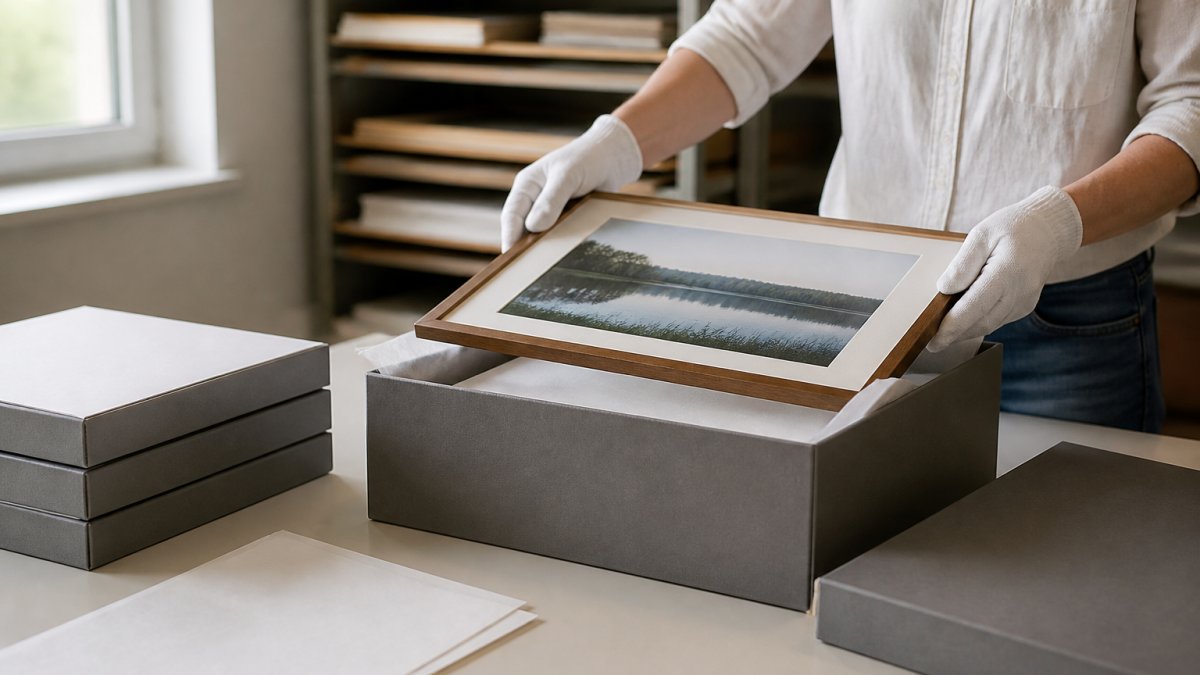
Most guides stop at "use acid-free boxes." That is necessary but not sufficient. The single biggest variable in whether a framed Crystal Archive print reaches its display rating is the frame package itself: glazing, mat, backing, and how the print is sealed against the room.
The Frame Package: Where Home Longevity Is Won or Lost
A framed print is a small microclimate. Four components control it:
- Glazing. UV-filtering glazing is one of the upgrades worth considering for any print hung near a window.
- Mat board. Use cotton rag or purified wood-pulp mat board rated for conservation. Standard paper mats are the most common source of acid migration and the cream-colored borders that show up years later. The mat also keeps the print off the glazing, preventing condensation transfer and ferrotyping (a glossy print sticking to glass).
- Backing board. Replace cardboard with acid-free foam board or corrugated plastic. Cardboard is acidic and hygroscopic; it pulls moisture into the package and off-gasses into the print.
- Sealing. A frame back sealed with acid-free tape or a fitted dust cover limits dust and pest ingress and slows humidity exchange with the room.
Home Storage: The Room Beats the Box
For unframed prints, the storage location matters more than the container. A closet shelf in a climate-controlled room outperforms an attic, garage, or basement every time, because those spaces swing in temperature and humidity far beyond what the paper tolerates.
- Use acid-free boxes, sleeves, and interleaving tissue
- Store flat or vertically in rigid, acid-free folders, never rolled tight
- Keep the archive space between 60-70°F with stable relative humidity under 50%
- Keep boxes off concrete floors and away from exterior walls
Avoid storing prints in a humid basement or against an exterior wall, where condensation is more likely to form.
Professional Archives: Same Principles, More Control
Professional archives add cold storage, monitored humidity, and inert enclosure systems for high-value holdings, but the underlying logic is identical: stable temperature, low humidity, acid-free contact materials, and minimal handling. The difference is consistency and monitoring, not secret equipment. A homeowner who controls the room and the frame package is running the same playbook at smaller scale.
Photo Paper Shelf Life: How Long Can Unused Paper Sit Before Printing?
Store unopened boxes in a refrigerator if you have the space, sealed against moisture, and let them reach room temperature before opening to prevent condensation. Opened packages should be resealed in their original black bag with the desiccant sachet.
This is why paper batch consistency matters for anyone printing at volume: fresh stock from a controlled supply chain is a longevity decision, not just a convenience.
Fuji Crystal Archive vs. Inkjet: How Print Durability Compares
The honest answer is that both technologies can be genuinely archival, and the best choice depends on the look you want and how the print will live. But "both are archival" hides the useful comparison: which Crystal Archive generation you are buying, and how each process behaves under light versus dark storage.
Crystal Archive Generations: What the Longevity Difference Actually Is
Crystal Archive is not one paper. The family spans generations with different dye sets and different published permanence profiles. The practical pattern most buyers encounter:
| Paper generation | Typical positioning | Display permanence pattern | Dark storage pattern |
|---|---|---|---|
| Crystal Archive Type II | Workhorse commercial/lab paper | Solid, but the lowest of the family under light | Strong; long dark-storage life |
| Crystal Archive Supreme | Higher-end lab paper | Improved light stability versus Type II | Very strong |
| Crystal Archive Digital / Professional lines | Optimized for digital exposure and pro workflows | Among the best in the family under display light | Very strong |
Two cautions on that table. First, published figures vary by testing lab and by the exact illuminant and humidity used, so treat any single number as a range, not a guarantee. Second, the generation matters less than the processing and display conditions: a well-processed Type II print in a UV-controlled frame will outlast a poorly processed premium paper in direct sun.
Silver Halide vs. Pigment Inkjet: Where Each Wins
Bumblejax's comparison of print longevity by process notes that some pigment-based inkjet combinations now match or exceed silver halide for fade resistance under light. That is a fair point, and we will not pretend otherwise. The comparison is more useful when split by failure mode:
| Factor | Fuji Crystal Archive | Pigment Inkjet |
|---|---|---|
| Display permanence | About 40 years at 500 lux for standard gallery conditions | Varies widely by ink and paper pairing; top combinations are competitive |
| Dark storage | Up to 133 years under controlled conditions | Strong, paper-dependent |
| Color gamut | Excellent, continuous tone | Wider in some combinations |
| Surface texture | Glossy and lustre options | Broad specialty finishes |
| Consistency | High batch-to-batch | Depends on printer calibration |
| Failure mode under light | Dye fading, often in highlights first | Ink fading and, on some papers, differential fade by color |
| Failure mode in humidity | Oxidative fading; RC base resists warping | Paper cockling and ink bleed on uncoated stocks |
A Practical Decision Rule
- Hanging in a bright room with daylight: prioritize UV-filtering glazing first, then a premium Crystal Archive generation or a top-tier pigment combination.
- Archiving in the dark: Crystal Archive's dark-storage profile is a genuine strength; store acid-free and cool.
- Chasing maximum gamut on specialty paper: pigment inkjet is the better fit, provided the printer is calibrated.
- Buying wall art at volume: batch consistency favors Crystal Archive, because the paper and process are standardized across labs.
Troubleshooting Print Degradation: Yellowing, Fading, and What to Do
Yellowing almost always traces to the paper base or mounting materials, not the image dyes.
Fading that hits the image first, especially in the highlights, points to light exposure or incomplete chemical processing. There is no fix for a faded print, only prevention for the next one.
A practical diagnostic checklist:
- White borders yellow, image intact: replace acidic mounting materials
- Highlights faded first: light damage, reframe with UV glazing
- Overall color shift: heat or humidity exposure during storage
- Stains near edges: handling oils, switch to gloves
If a print has already degraded, a professional conservator can sometimes slow further damage, but reversal is rarely possible.
Choosing Archival Wall Art for Your Home
At American Luxury Gifts, every piece is handmade in Virginia on premium lustre Fuji Crystal Archive photo paper.
If you have ever watched a cheap print peel or fade within a year, the fix is not a different wall. It is a different paper.
Frequently Asked Questions
How long do Fuji Crystal Archive prints last?
Actual Fuji Crystal Archive print longevity depends on light exposure, humidity, and framing materials.
Does sunlight make Fuji Crystal Archive prints fade?
Yes. Direct sunlight accelerates fading dramatically, even on archival silver halide papers. UV exposure breaks down dye stability in the emulsion layer over time. To prevent photo prints from fading, keep them out of direct sun, use UV-filtering glass in frames, and rotate prints that hang in bright rooms.
Does photo paper go bad if stored unused?
Yes, photo paper shelf life is limited. Unopened Fuji Crystal Archive paper typically stays usable for about two to three years when kept in a cool, dry place, and opened packages degrade faster once exposed to humidity. Store unused paper sealed, flat, and away from heat sources. Paper past its shelf life can show color shifts, banding, or reduced density range in the final print.
How should you store Fuji Crystal Archive prints for long-term preservation?
Follow photo print storage best practices: keep prints in acid-free storage boxes, maintain relative humidity between 30 and 50 percent, and store at temperatures below 75 degrees Fahrenheit. Avoid attics, basements, and garages where humidity swings. For framed pieces, use acid-free mounting materials and keep them off exterior walls that collect moisture. These steps protect the emulsion layer and slow oxidative fading.
Hanging art that survives decades takes more than a good frame. American Luxury Gifts prints every piece on high-resolution Fuji Crystal Archive photo paper with a premium lustre finish, handmade in Virginia and built for the long haul. Browse our curated collections and find a piece that earns its place on your wall. [View the Collection]


