Classic Rock Themed Wall Art for Music Fans
The right rock-inspired art does more than fill a blank wall; it sets the room’s mood. Classic rock themed wall art might feature vintage-inspired designs, artist imagery, or album-era visuals. The image, print format, and display method all shape how it feels in your space.
Choosing a piece can be personal. You might want a favorite artist to anchor a music room, a nostalgic concert-poster look for a studio, or a subtle nod to classic rock in a living room. The best fit depends on the image you connect with, the wall you’re decorating, and how prominent you want the art to be.
Explore how vintage promos and artist posters differ, what to consider when choosing print formats and framing, and how to place music-inspired art in rooms where it feels at home. You’ll come away with practical ways to narrow your options and choose a piece that reflects your taste without overwhelming the space.
Key Takeaways
- Compare vintage tour-promo designs with artist-focused posters to find the look that best reflects your connection to classic rock.
- Choose imagery that feels personal, from a favorite performer to a visual nod to the era’s concert-poster style.
- Consider print format and framing together so the artwork suits your wall and the finish you want.
- Use the room’s purpose and existing decor to guide placement, from a dedicated music space to a shared living area.
- Explore music-inspired wall art alongside other themes when you want your decor to express more than one part of your personality.
Concert posters and vintage tour promos
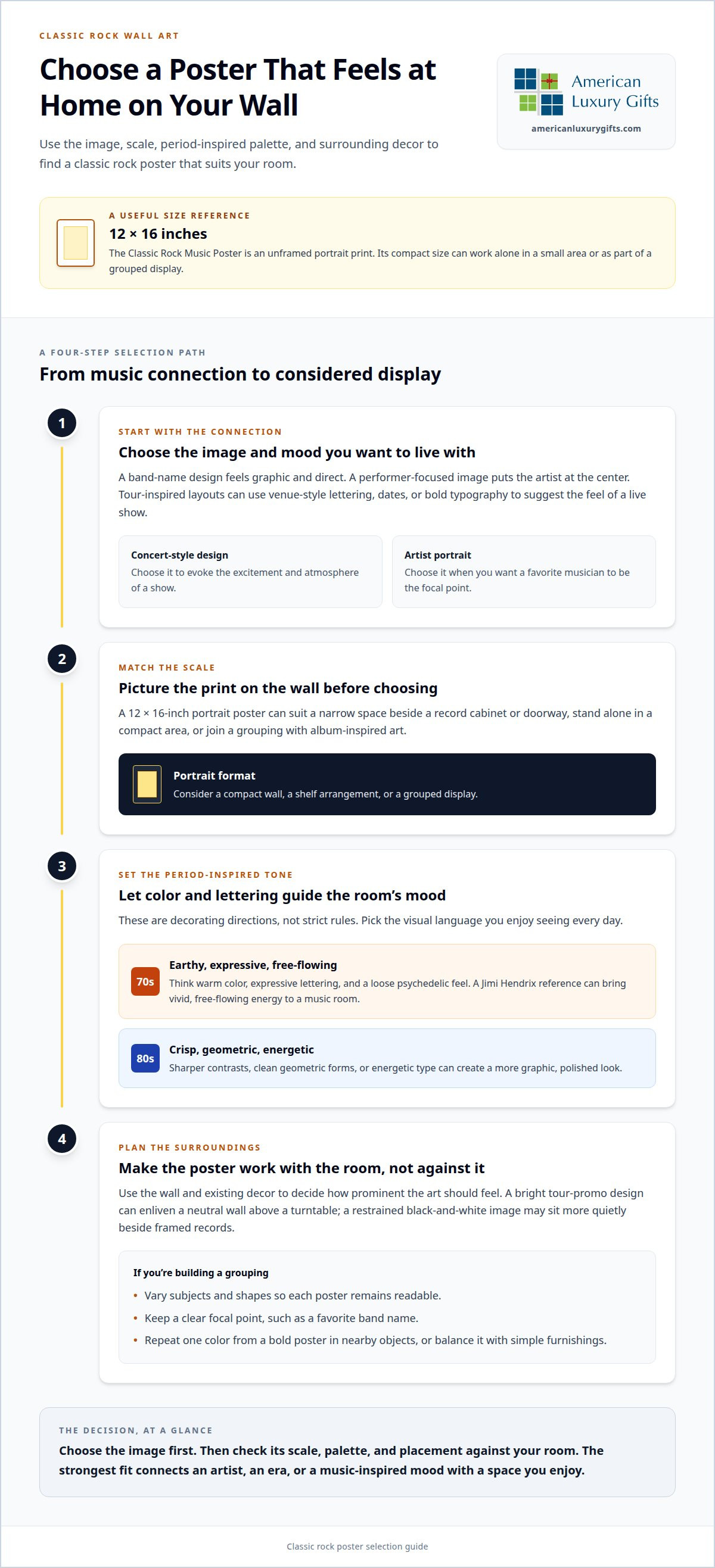
Concert posters and vintage tour promos bring a live-show feel to a room through bold lettering, artist imagery, and event-inspired layouts. A Classic Rock Music Poster is an unframed 12-by-16-inch print, making it a straightforward option for a smaller wall, shelf arrangement, or grouped display. Its portrait shape also suits narrow spaces beside a record cabinet or doorway.
Start by choosing the visual mood. A design built around a band name feels graphic and direct, while a performer-focused image makes the artist central. Tour-inspired layouts may use venue-style lettering, dates, or bold typography. Consider how these elements work together and whether the overall design suits your room.
For a 1970s-inspired look, consider earthy color, expressive lettering, and a loose, psychedelic feel. A design referencing Jimi Hendrix, for example, can bring a vivid, free-flowing quality to a music room. For an 1980s-inspired look, sharper contrasts, clean geometric forms, or energetic type can feel more graphic and polished. These are useful decorating directions, not strict rules; choose the visual language you enjoy seeing every day.
Use this quick selection process to narrow the options:
- Choose the memory or mood. A concert-style design can evoke the excitement of a show, while an artist portrait keeps attention on a favorite musician.
- Match the scale to the wall. The 12-by-16-inch poster can stand alone in a compact area or join a grouping with album-inspired art.
- Pick a period-inspired palette. Try warm, expressive colors for a 1970s feel or crisp contrast for an 1980s look.
- Plan the surrounding decor. Pair a bold poster with simple furnishings, or repeat one of its colors in nearby objects.
Before settling on a vintage music poster, picture it alongside the items already in the room. A bright tour-promo design can enliven a neutral wall above a turntable, while a restrained black-and-white image may sit more quietly beside framed records. If you’re arranging several pieces, vary their subjects and shapes so each poster remains readable. A clear focal point, such as a favorite band name, helps the display feel intentional rather than crowded.
The strongest choice connects an artist, era, or music-inspired mood with your space. Choose the image first, then consider its colors and placement so it feels at home.
Posters featuring iconic rock artists
When shopping for a specific artist’s official merchandise, look for licensing details in the product description and clear seller information. A named artist or recognizable design alone does not establish that a product is officially licensed.
An artist poster can make a personal connection the room’s focal point. Jimi Hendrix imagery, for example, may suit a guitar room, while a Grateful Dead design can speak to a fan drawn to the band’s visual identity. Choose a recognizable portrait for an artist-centered display, or select a performance image when movement and atmosphere matter more.
Independent artists offer another route: original artwork shaped by rock culture, rather than a reproduction of a familiar promotional image. A hand-drawn guitar, expressive lettering, or a collage inspired by album-era colors can evoke classic rock without making a specific musician the subject. If an independent design depicts a named artist, band logo, or album cover, look for clear licensing information instead of assuming the artist’s name proves authorization.
Before buying, use these practical checks:
- Read the listing closely. Look for explicit licensing language and the name of the rights holder, not just “classic” or “authentic” in the title.
- Identify the creator. A named photographer, illustrator, or design studio gives you a clearer sense of who made the image.
- Review the artwork shown. Compare the listing image with the described artist, band, or era; mismatched details are a reason to pause.
- Check the item description. Confirm that the listing describes a physical poster and explains its format, rather than relying on a thumbnail alone.
Online marketplaces can bring together licensed merchandise, independent designs, and unauthorized reproductions. Risks include unclear licensing, misleading descriptions, copied artwork, and a delivered print that differs from the listing image. Marketplace seller reviews can describe past transactions, but they don’t establish that a poster is officially licensed.
For a music-inspired gift, consider the recipient’s connection to the artwork. A performance image may suit someone drawn to the energy of live music, while a more understated portrait may feel right in a shared living space. An illustrated design can appeal to someone who prefers a less familiar visual approach.
Choose the image first, then consider its creator, any licensing details, and how it will look in the room. This helps you select a piece with a meaningful connection to the music and a clearer understanding of the product.
Print formats and framing options
Classic rock wall art costs vary with print format, artwork dimensions, and framing, so the format alone doesn’t set a typical price. Compare the same design across available options, then consider how its size and finish suit your room.
A poster print keeps attention on the image and offers a straightforward, unframed presentation. For example, an Alternative Rock Music Poster is listed as an unframed 12-by-16-inch print. That compact portrait format can fit a narrow wall or join a larger arrangement without dominating it.
Framed prints add a finished border around the artwork, while floating frames create a distinct space between the print and frame. Metal prints offer a different surface and presentation. These formats can have different starting prices, but no single figure applies across designs and sizes. Compare the exact artwork and format you want rather than treating a category starting price as a universal cost.
Size changes the visual impact and the wall space required. A Vintage Album Record wall-art design is available in a 12-by-16-inch size, while the oversized filter covers artwork over 60 inches. A compact print can suit a desk or small music nook; an oversized piece may become the room’s focal point. Measure the wall area before choosing a large format.
Sets create another option. A guitar silhouette wall-art set contains three pieces, each measuring 11 by 40 inches. Its long, narrow panels can spread across a wide wall, unlike a single portrait print. Check the arrangement and spacing available so the pieces read as one display rather than competing accents.
- Choose the format. Decide between an unframed poster, framed print, floating frame, or metal presentation.
- Match the dimensions. Compare the artwork measurements with the open wall, furniture, and nearby decor.
- Consider the arrangement. A single 12-by-16-inch print and a three-piece guitar set create very different visual weight.
- Compare like with like. Review the same design and size across formats to understand what affects the listed price.
The way you display a print shapes its look in the room. Before buying, consider whether you prefer a frame or another presentation, and how that choice will work with nearby furniture and décor. Check the product details so you know what is included.
For a music room, a large-format piece can anchor the wall above seating. In a smaller space, a poster or record-inspired print may fit more naturally. Let the available wall, preferred finish, and artwork dimensions guide your choice.
Prices depend on the specific product. Check the listed price and details for the piece you want rather than assuming that all designs or formats cost the same.
Wall art for music rooms, living spaces, dorms, and studios
Choose artwork according to the room’s purpose, wall space, and the feeling you want to create. A music room can support a striking Jimi Hendrix image, while a shared living room may suit a more balanced Fleetwood Mac or Grateful Dead design. The category lists 111 classic rock artworks, offering varied subjects to consider.
For a dedicated music room, place a favorite musician or band near the space where you listen, practice, or display records. A close-up bass guitar image can complement an instrument corner, while a Jethro Tull artwork can introduce a band-focused accent. Keep the central image visible from the room’s main seat, and arrange smaller decor around it rather than across it.
Living spaces benefit from artwork that connects with the room’s existing palette. A black-and-white Jimi Hendrix image can sit comfortably among neutral furnishings, while a colorful Fleetwood Mac piece can echo cushions or a rug. For a shared space, choose a recognizable artist image that reflects your taste without making every wall feel like a concert venue. One focal piece often gives the room enough musical character.
Dorm rooms and studios have different needs. In a dorm, a portrait-format Lynyrd Skynyrd or Creedence Clearwater Revival print can add personality above a desk or bed. In a home studio, a guitar image or Jimi Hendrix performance artwork can reinforce the creative atmosphere. Leave clear space around the work area, so the art adds energy without crowding equipment, shelving, or the desk.
Band and musician portraits make a display feel personal, especially when each selection connects to a specific memory or listening habit. For a cohesive arrangement, choose one anchor image, then add complementary subjects such as a guitar detail or a second band. A Grateful Dead artwork can lead the composition, with a restrained instrument image nearby. Keep frame styles or color tones consistent to help different images feel connected.
- Music room: Choose a favorite performer or instrument image near the listening area.
- Living room: Match the artwork’s colors and visual intensity to existing furnishings.
- Dorm: Use a focused artist portrait above a desk or bed.
- Studio: Place music imagery where it inspires, without obstructing work surfaces.
Think of the room as part of the display. A Jimi Hendrix portrait can energize a studio, while Creedence Clearwater Revival artwork may give a living area a distinctly personal touch. The strongest placement makes the music visible while respecting how you use the space.
Explore music and TV wall art prints
American Luxury Gifts
American Luxury Gifts offers Music & TV Wall Art Prints alongside collections such as Motivational, Inspirational, and Christian & Spiritual Wall Art Prints. These physical art prints provide options for choosing a theme that reflects your interests or helps shape a room’s mood.
Explore the available themes when you’re deciding between a music-inspired design and artwork that expresses another interest. Consider the room, the intended recipient, and the feeling you want the art to bring to the space.
Explore American Luxury Gifts’ wall art collections to find a theme that suits your space or gift.
Choose Art That Feels Like Your Soundtrack
Let the music you love guide a choice that feels personal to you, not simply familiar on the wall. Classic rock themed wall art can mark a favorite era, celebrate an artist, or give a listening space a character that feels distinctly yours. Take a moment to picture where you’ll see it each day and what you want that room to say.
If you’re also choosing art for another space or recipient, American Luxury Gifts offers Motivational Wall Art Prints, Inspirational Wall Art Prints, and Christian & Spiritual Wall Art Prints. A different theme can carry a different message while keeping your choices thoughtful.
Choose wall art that reflects what matters to you. Explore American Luxury Gifts’ collections to find a theme that feels right for your space.
Frequently Asked Questions
What styles of classic rock themed wall art are available?
Music-inspired artwork can use photography, illustration, typography, or graphic design. A dramatic performance image creates a different impression from a stylized illustration, even when the subject is similar. Choose a visual approach that reflects how you connect with the music, not just a familiar name.
What sizes and materials are available for classic rock posters and canvas prints?
Sizes and materials depend on the specific artwork and product. The art prints from American Luxury Gifts use luster-finish Fuji Crystal Archive photo paper; canvas is a separate format and shouldn’t be assumed to describe every print. For a particular piece, use its listed product details to identify the material and dimensions. This helps you distinguish the physical print from other formats before deciding.
What are the best ways to frame and display classic rock wall art?
Choose a display method that suits the print and the way you want to maintain it. A frame can protect the paper from handling, while a clean, simple presentation keeps attention on intricate artwork. For a gift, consider the recipient’s existing display preferences before choosing a frame style. If you’re creating a collection over time, keeping a consistent presentation can help new pieces feel connected.
How do I choose classic rock wall art for a room's decor and color scheme?
Consider the room’s overall visual energy, not only its exact colors. A dramatic performance image may suit a space with bold furnishings, while a quieter portrait can work in a room designed for reading or conversation. Also think about who uses the room. In a shared space, choose imagery that feels meaningful to you without relying on inside references that guests may not recognize.
How can I choose artwork that reflects my connection to a band?
Think about what you value most: the group’s identity, a particular musician, or a memory tied to its music. A band-centered design can represent years of listening, while an image of one performer may reflect a specific influence. If you’re buying for another fan, their favorite album, instrument, or period can help guide your choice without needing to guess at a design they’ll enjoy.


