Abstract Art Prints for Colorful, Modern Homes
The boldest abstract art prints aren’t always the most colorful. Choose a vivid design when you want the artwork to stand out; muted tones add movement without overwhelming the room. The best choice depends on your existing palette and the mood you want to create.
A striking design can catch your eye, yet you may still wonder how it will look with your furniture, wall color, and everyday surroundings. A little planning helps you choose artwork that feels intentional, whether you’re refreshing a living room or adding character to a quiet corner.
Explore how vivid and muted palettes shape a room, what canvas, framed art, and poster formats bring to a display, and how abstract designs can complement Scandinavian and modern interiors. You’ll also find practical ways to consider scale, placement, and visual balance before choosing a print, so your final selection feels at home in your space.
Key Takeaways
- Choose vivid colors to create a focal point, or softer tones to add movement while keeping the room calm.
- Compare canvas, framed art, and posters by considering the look you want and how the piece will fit your space.
- For Scandinavian interiors, give artwork breathing room and keep nearby decor visually simple.
- Explore different abstract designs, from organic shapes to geometric patterns, to find a style that complements your furnishings.
- Match the artwork’s mood to the room’s purpose, such as energizing a shared living area or creating a quieter bedroom feel.
Vibrant and subtle color styles
Match the artwork’s scale to the wall and its colors to the room’s palette. Compare the print with nearby furniture, then look for a shade you can repeat from a rug, pillow, or accent chair. Tape a paper outline above a sofa to judge the print’s visual footprint before choosing.
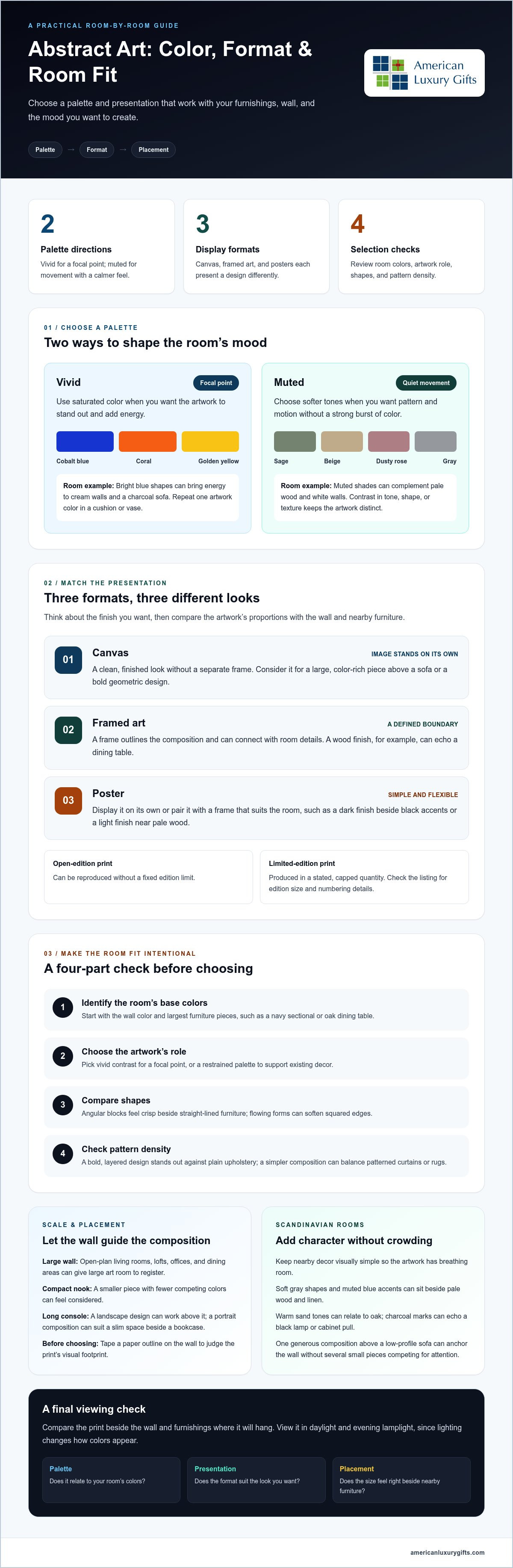
Vibrant abstract art prints can give a neutral room a clear focal point. Look for saturated colors such as cobalt blue, coral, or golden yellow, then echo one shade in a cushion or vase. In a living room with cream walls and a charcoal sofa, a composition with bright blue shapes can add energy without requiring a full room makeover.
Subtle palettes suit spaces where you want pattern and movement without a strong burst of color. Consider muted sage, warm beige, dusty rose, or soft gray. A print built around those shades can complement pale wood furniture and white walls, while gentle curves or layered forms keep the design from feeling flat. The key is contrast: even a quiet palette needs differences in tone, shape, or texture to remain distinct on the wall.
Color, shape, and pattern work together. Use these steps before choosing:
- Identify the room’s base colors. Note the wall color and the largest furniture pieces, such as a navy sectional or oak dining table.
- Choose the artwork’s role. Pick vivid contrast for a focal point, or a restrained palette to support existing decor.
- Compare shapes. Angular blocks feel crisp beside straight-lined furniture; flowing forms soften a room with squared edges.
- Check pattern density. A bold, layered design stands out against plain upholstery, while a simpler composition balances patterned curtains or rugs.
Room size and placement also affect how colors read. Large abstract art can suit open-plan living rooms, lofts, offices, and dining areas, where an expansive wall gives the composition room to register. In a compact reading nook, a smaller piece with fewer competing colors can feel more considered. If your dining chairs have a pattern, choose a design that repeats one chair color instead of introducing several new shades.
Before settling on a palette, view the print near the wall where it will hang and beside the furnishings around it. Compare it in daylight and evening lamplight, since lighting changes how colors appear. Warm terracotta may feel lively beside a cream sofa, but more subdued against dark green. This simple comparison helps you choose a design that suits the room throughout the day.
Canvas prints, framed art, and posters
Choose canvas, framed art, or a poster based on the presentation you want and the space available. A canvas can create a clean, finished look without a separate frame; curated sources like MIORLUNE — Private Art House demonstrate how luxury canvas pieces bring depth and presence to considered interiors. Framed art adds a visible border, while a poster offers a simple, flexible display. For example, a bold geometric design can feel more substantial on canvas, while a smaller print can suit a narrow hallway.
Open-edition prints can be reproduced without a fixed edition limit, while limited-edition prints are produced in a stated, capped quantity. If exclusivity matters to you, look for the edition size and numbering details in the listing. If you’re choosing mainly for color and composition, the edition type may matter less than the artwork itself.
Canvas, frames, and posters each change how a design reads on the wall. A canvas may keep attention on the artwork’s edges, while a frame creates a boundary that can connect with nearby furniture or finishes. A poster can be paired with a frame that suits your room, such as a dark frame beside black accents or a light finish near pale wood.
To frame and hang abstract art prints, select a frame that complements the artwork, then position the piece in relation to nearby furniture and sightlines. For example, center a framed print above a console table, or arrange smaller prints with consistent spacing for a deliberate gallery display.
- Canvas: Consider it when you want the image to stand on its own, such as a large, color-rich piece above a sofa.
- Framed art: Choose a frame to define the composition and connect it with room details, such as a wood finish that echoes a dining table.
- Poster: Consider this format when you want a straightforward print that can be displayed alone or framed to suit your decor.
Return eligibility, shipping charges, delivery timing, and remedies for damage depend on the seller’s stated terms and the order’s condition. Relevant details include the return period, packaging requirements, shipping responsibility, and the process for documenting damage upon delivery.
Before ordering, compare the artwork’s proportions with the wall and furniture it will accompany. A portrait composition can fit a slim space beside a bookcase, while a landscape design can work above a long console. Explore abstract art designs with the display format and placement in mind, then choose the presentation that feels cohesive in your room.
Abstract art for Scandinavian decor
Scandinavian rooms often pair simple forms with natural materials and a restrained palette. Choose artwork that adds character without crowding those elements. For example, soft gray shapes and muted blue accents can sit comfortably beside a pale wood dining table and linen curtains. Let the print bring interest while the room’s uncluttered feel remains intact.
Give a large abstract piece breathing room. An open-plan living room, loft, office, or dining area can accommodate large art, but keep nearby visual competition minimal. Above a low-profile sofa, one generous composition can anchor the wall more quietly than several small pieces competing for attention. Keep the surrounding wall clear so the artwork’s shapes remain easy to read.
Use the room’s existing materials as a guide. Warm sand tones can relate to oak furniture, while charcoal marks can echo a black lamp or cabinet pull. If your space has white walls, pale floors, and natural textures, a restrained palette can preserve its calm. A single contrasting color, such as muted rust, adds definition without creating a busy mix.
Consider these design choices for a Scandinavian-inspired room:
- Organic forms: Flowing shapes can soften a space with straight-edged shelves and simple furniture.
- Geometric forms: Clean arcs or blocks can reinforce the orderly lines of a modern dining set.
- Limited color: A composition in cream, gray, and muted green can complement natural wood.
- Open composition: Broad areas of visual space help a print feel composed rather than crowded.
Placement matters as much as the image. In a bedroom, hang a quiet design where you can see it from the bed without competing with patterned bedding. In a living room, align the piece with the sofa or console beneath it, rather than leaving it disconnected from the furniture. A print above a dining table can also establish a focal point, especially when the table setting stays simple.
Before choosing, take three practical steps: identify the room’s strongest material, select one or two related colors, then compare designs for visual weight. A light oak room with white walls may suit a pale composition, while a dark wood sideboard can support stronger contrast. Keep nearby decor selective. A sculptural vase or leafy plant can complement the artwork, but several competing wall pieces may weaken its presence.
Give a large abstract work generous space, and keep nearby visual elements understated so its forms can hold attention.
Abstract art print designs
Start with the design’s visual structure: its shapes, movement, and balance. Geometric compositions use clear lines and repeated forms, while gestural designs suggest motion through loose marks. Color-field artwork gives broad areas of color the leading role. Overlapping shapes can feel energetic; open space can create a quieter effect.
How much do abstract art prints cost? Prices vary with format, size, materials, and whether a print belongs to a limited edition. Compare the complete listing details rather than judging cost by the image alone.
To assess a print, inspect the preview for crisp edges, distinct details, and smooth color transitions. Read the listing for the format and dimensions, then consider whether they suit your intended display. For example, a design with fine lines needs a clear preview so you can see its detail.
Different design approaches create different effects. Use these visual cues to narrow your choice:
- Geometric: Repeated circles, rectangles, or angled lines can give a room a structured focal point.
- Gestural: Loose strokes and irregular marks bring visible movement to a simple wall.
- Organic: Uneven, nature-inspired forms can soften a room dominated by straight furniture edges.
- Color field: Broad areas of one or two colors make hue and composition the main features.
- Layered: Overlapping shapes create depth, especially when each form remains easy to distinguish.
Consider the composition’s visual weight before choosing a design. Dark shapes concentrated near one edge may feel unbalanced beside a narrow bookcase, but work above a wider wall with room around them. An off-center design, for instance, can suit a console when its open side visually balances a lamp nearby.
Use a simple selection process. First, decide what should draw attention: line, shape, color, or texture. Next, compare the composition with the room’s strongest patterns, such as striped upholstery or a veined stone tabletop. Then consider viewing distance. Fine marks may be harder to appreciate across a large living room, while broad shapes remain legible from farther away.
Finally, choose a design that adds something distinct rather than duplicating every nearby object. A room with rounded lamps and curved furniture might benefit from crisp geometry. A space with angular shelves could feel more inviting with flowing forms. Browse abstract art designs and compare their structure, detail, and visual balance with your intended wall.
American Luxury Gifts: Motivational Wall Art Prints
American Luxury Gifts offers abstract art prints alongside Motivational and Inspirational Wall Art Prints. Its Christian & Spiritual and Music & TV Wall Art Prints offer other ways to bring personal meaning into a room. Browse the collections to compare designs and find one that suits your space.
Consider the feeling you want the artwork to create. A motivational design can add an encouraging note to a home office, while an abstract print can bring visual interest to a living room. Browse American Luxury Gifts’ designs and choose one that fits your room and personal taste.
Visit americanluxurygifts.com to explore the wall art.
Make Your Walls Feel More Like You
Let your final choice reflect how you want to experience the room, not simply what matches today’s decor. Abstract art prints can become a personal point of connection, adding a visual note that feels distinctly yours. Choose a design you’ll enjoy seeing as your home changes around it.
American Luxury Gifts also offers Motivational Wall Art Prints, Inspirational Wall Art Prints, and Christian & Spiritual Wall Art Prints for spaces where you want the artwork to express more than color and form. Explore the designs at your own pace and consider which one feels right for your home.
Your home can take shape one thoughtful choice at a time. Trust your eye, choose what resonates, and enjoy the character it brings to your walls.
Frequently Asked Questions
What defines abstract art?
Abstract art uses visual elements to suggest ideas or feelings without depicting a subject literally. Repeated marks might imply rhythm, while shifting shapes can suggest movement. You can respond to the colors, forms, or mood without identifying a specific object. That openness makes interpretation personal: two people may see different things in the same artwork.
What styles of abstract art are popular?
Fluid marbling and fragmented collage offer alternatives to orderly geometric compositions. Marbling creates movement through blended, swirling forms; collage uses distinct shapes and visual layers for contrast. Notice whether you prefer continuous movement or clearly separated elements. A product preview can help you decide which style feels engaging rather than visually overwhelming.
What print materials and printing methods are best for abstract art?
The right material depends on the artwork and the display you have in mind. Check the product description for the specific surface and format, since these affect the print’s appearance. American Luxury Gifts states that its art prints use luster-finish Fuji Crystal Archive photo paper. If the design relies on subtle color shifts, examine the available preview closely before making your selection.
Does abstract art need to have a specific meaning?
No. You can choose a piece for its colors, movement, or emotional tone without assigning it a fixed message. You might enjoy a composition because its flowing forms feel peaceful, even if you can’t name what they represent. If a work brings a personal memory or idea to mind, that interpretation can be meaningful to you without being the only valid reading.
Can abstract art make a thoughtful gift?
Yes, especially when you choose a design with the recipient’s taste and home in mind. Consider what they enjoy, such as calm colors, expressive forms, or a particular room’s decor. For a housewarming gift, a composition that suits their established style can feel personal without requiring you to know a precise message. The strongest choice reflects their preferences, not just yours.


